
Peptide Therapy for Weight Loss: What Does the Evidence Show?
Evidence & Clinical Considerations for Healthcare Professionals
Why "Weight Loss Peptides" Is Too Broad a Category
Search for "peptides for weight loss" and you will find a surprisingly broad collection of compounds discussed under the same label.
Clinically, that can be misleading.
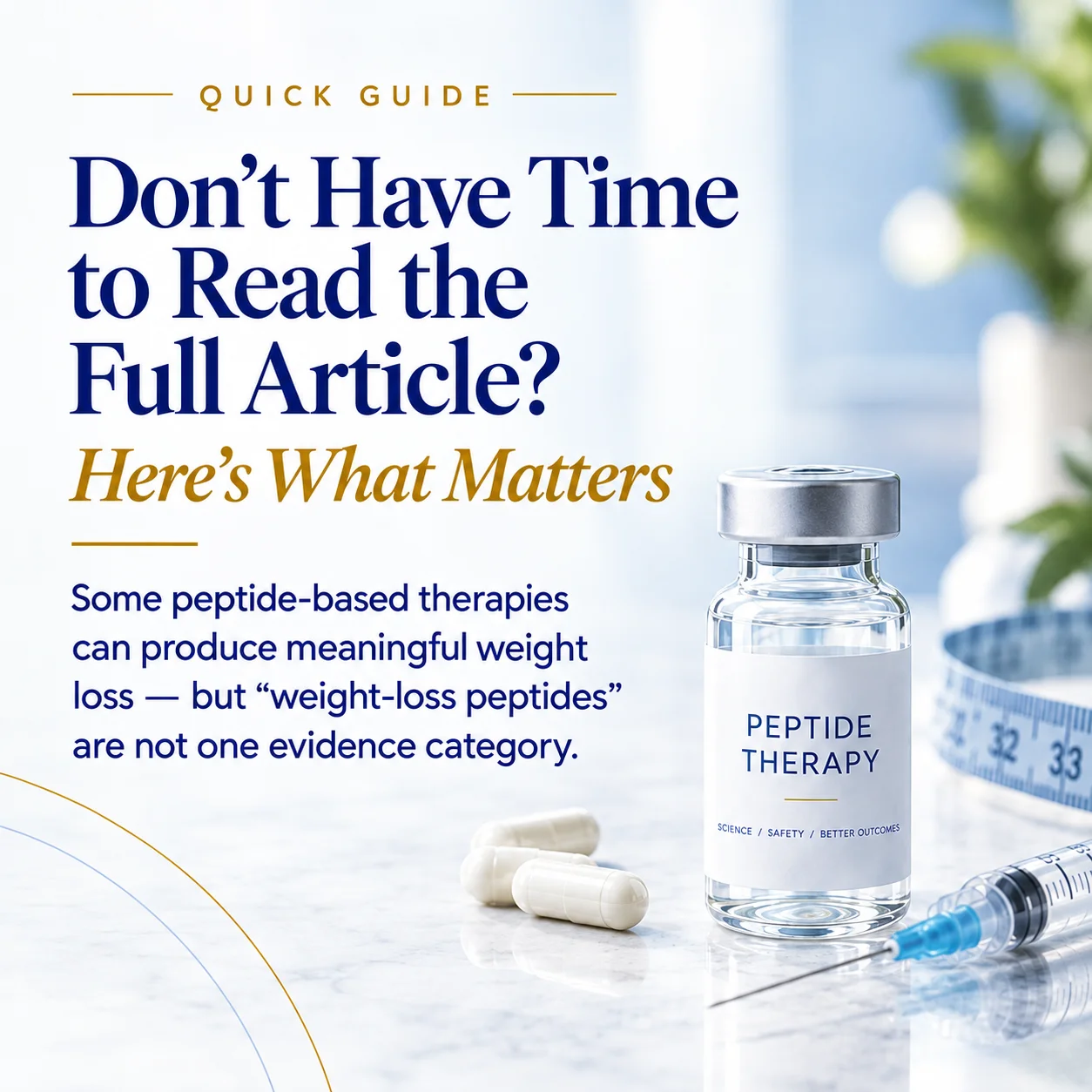
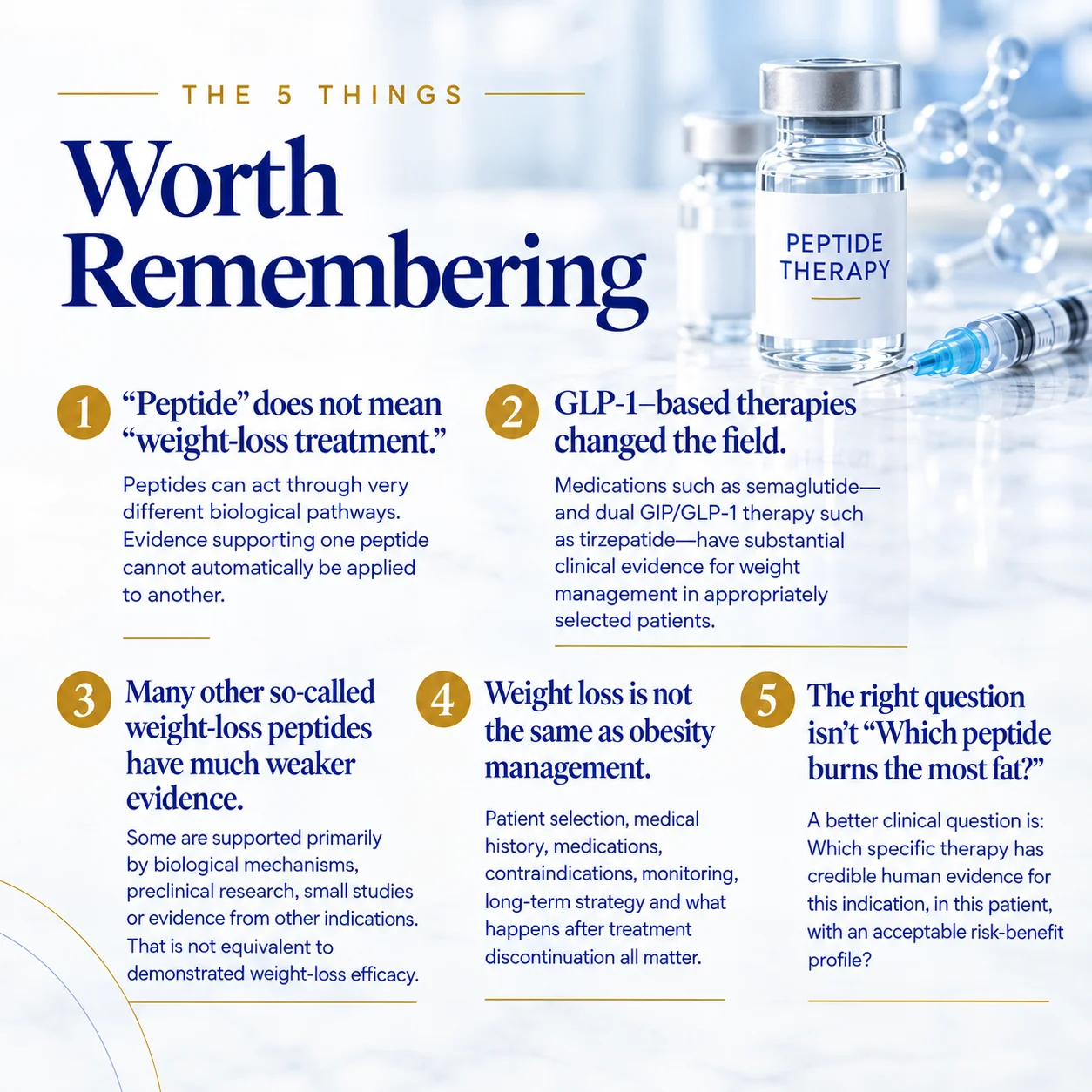
Peptides are short chains of amino acids that can function as signaling molecules. But belonging to the same broad molecular category does not mean two peptides have the same mechanism, indication, efficacy or safety profile.
A peptide involved in appetite signaling cannot automatically be compared with another being investigated for tissue repair, growth-hormone signaling, body composition or metabolic function.
The clinical question therefore needs to move beyond the category.
Instead of asking: "Do peptides work for weight loss?"
Ask: "Which peptide, acting through which pathway, has demonstrated which outcome, in which patient population?"
That is a much more useful question.
What Peptide Therapies Have the Strongest Evidence for Weight Loss?
At present, the strongest evidence comes from therapies targeting the incretin system.
Two prominent examples are semaglutide and tirzepatide. They should not, however, be treated as interchangeable with every compound marketed as a "weight-loss peptide."
Semaglutide
Semaglutide is a GLP-1 receptor agonist. GLP-1 signaling is involved in several physiological processes relevant to weight management, including appetite and satiety.
Clinical trials have demonstrated meaningful weight reduction with semaglutide in appropriately selected populations when combined with lifestyle intervention.
Importantly, the evidence behind semaglutide comes from structured clinical development—not simply from biological plausibility or anecdotal use.
In 2026, the U.S. FDA also approved a higher-dose Wegovy formulation for weight loss and long-term maintenance of weight reduction in certain adults with obesity or overweight plus at least one weight-related condition.
Tirzepatide
Tirzepatide acts through both GIP and GLP-1 receptor pathways.
In the SURMOUNT-1 randomized clinical trial, tirzepatide produced substantial reductions in body weight among adults with obesity or overweight without diabetes.
The FDA subsequently approved tirzepatide under the Zepbound brand for chronic weight management in eligible adults alongside reduced-calorie diet and increased physical activity.
More recent research has moved beyond the initial question of whether weight loss occurs and toward another clinically important question: Can the reduction be maintained?
The 2026 SURMOUNT-MAINTAIN randomized trial specifically investigated maintenance of body-weight reduction following tirzepatide treatment.
Established Evidence vs Emerging Evidence
This distinction is where the peptide conversation becomes more complicated. Not every compound associated with metabolism belongs in the same evidence category as established incretin-based pharmacotherapy.
A useful way to interpret the field is through three evidence zones.
🟢 Established Clinical Evidence
This category includes therapies supported by substantial human clinical research for defined indications.
Characteristics generally include:
- Randomized clinical trials
- Meaningful clinical endpoints
- Clearly defined patient populations
- Systematic safety assessment
- Reproducible findings
- Regulatory evaluation
GLP-1–based obesity pharmacotherapy currently represents the clearest example within the broader peptide conversation.
🟡 Emerging Evidence
This category is much larger and may include peptide-related interventions supported by:
- Plausible biological mechanisms
- Animal research
- Early human trials
- Small clinical studies
- Surrogate outcomes
- Evidence from another indication
- Observational clinical experience
None of these automatically makes a therapy ineffective, but they also do not provide the same level of certainty as large, well-designed clinical trials.
🔴 Marketing Ahead
This is where practitioners should become particularly cautious.
Terms frequently encountered online include:
- Fat-burning peptides
- Metabolism-boosting peptides
- Anti-obesity peptides
- Rapid weight-loss peptides
- Body-composition peptides
The language may sound scientific. That does not mean the underlying clinical claim has been established.
What Does "Evidence-Based Peptide Therapy" Actually Mean?
The phrase evidence-based is used frequently in medicine. Sometimes too frequently.
For peptide therapy, evidence-based practice should mean more than finding a study that mentions a compound. Practitioners need to examine the quality and relevance of the evidence.
Consider Two Hypothetical Situations
Peptide A
A large randomized controlled trial demonstrates clinically meaningful weight reduction in a clearly defined patient population.
Peptide B
Animal research suggests that the compound may influence a metabolic pathway associated with fat metabolism.
Both may be scientifically interesting. But they answer completely different questions.
Peptide A provides evidence about a clinical outcome in humans. Peptide B provides evidence about a potential biological mechanism.
Treating these as equivalent is one of the easiest ways to overstate emerging peptide science.
The CBAM Evidence Test for Any "Weight-Loss Peptide"
When healthcare professionals encounter a new peptide promoted for weight management, four questions can rapidly clarify the discussion.
1. What Is the Molecule?
Start with the actual compound—not the marketing category. "Weight-loss peptide" is not specific enough.
2. What Is the Proposed Mechanism?
Which receptor, pathway or physiological process is involved? Mechanistic understanding helps determine whether a claim is biologically plausible. But mechanism alone is not proof of effectiveness.
3. What Human Evidence Supports the Outcome?
Look beyond: "Has it been studied?" Ask: What did the study actually demonstrate? Weight change? Body composition? Appetite? A biomarker? An animal outcome? These are not interchangeable.
4. What Is the Regulatory and Safety Context?
Is the therapy approved for the proposed indication? Is it being prescribed off-label? Is it compounded? Is it investigational? What professional and jurisdictional requirements apply?
Why GLP-1 Success Should Not Be Generalized to Every Peptide
The rapid rise of GLP-1–based medications dramatically increased public awareness of peptide-based therapeutics. That is scientifically interesting. It has also created a marketing problem.
Success in one peptide-related therapeutic category can create the impression that the entire peptide field has been clinically validated. It has not.
Semaglutide and tirzepatide went through extensive clinical development programs. Their evidence cannot simply be transferred to unrelated compounds because those compounds also happen to be peptides.
Think of it this way: The success of one antibiotic does not prove that every antimicrobial compound works. The success of one peptide-based therapy does not validate every peptide therapy either.
For clinicians, this distinction is fundamental.
Approved, Compounded and Investigational Are Not the Same Thing
This is another area where terminology matters. A patient may hear that a product "contains semaglutide" or is "similar to" an approved medication and assume that the products are clinically equivalent.
That assumption can be incorrect.
The FDA states that compounded drugs are not FDA-approved and do not undergo FDA premarket review for safety, effectiveness or quality. The agency has also reported concerns involving compounded semaglutide and tirzepatide products, including dosing errors, fraudulent products, storage issues and misleading marketing.
The FDA's position is that compounded drugs should generally be used when a patient's medical needs cannot be met by an available FDA-approved drug.
Weight Loss Is Not the Same as Obesity Management
A patient may ask: "Which peptide will help me lose weight?"
A clinician has to ask considerably more.
For example:
- Is obesity or overweight clinically present?
- Is pharmacotherapy indicated?
- Are weight-related comorbidities present?
- What previous interventions have been attempted?
- What medications is the patient taking?
- Are relevant contraindications present?
- What is the patient's metabolic and endocrine history?
- What are their nutritional and behavioral patterns?
- What outcomes are clinically meaningful?
- How will progress be monitored?
- What is the long-term treatment strategy?
- What happens if therapy is discontinued?
Peptide therapy education for healthcare professionals therefore needs to extend well beyond lists of compounds. For a broader clinical overview of peptide mechanisms, applications, safety and evidence evaluation, see the CBAM Peptide Therapy Guide.
The Question Most Weight-Loss Content Ignores: What Happens Next?
Imagine a therapy produces significant weight reduction. That is obviously important.
But it is not the end of the clinical question.
- What happens after six months?
- After one year?
- What happens if treatment continues?
- What happens if it stops?
- Can weight reduction be maintained?
- What happens to appetite?
- What happens to metabolic risk factors?
- What is the patient's long-term management strategy?
These questions are becoming increasingly important as obesity pharmacotherapy moves from short-term weight reduction toward chronic disease management.
Recent trials examining maintenance after tirzepatide-induced weight loss illustrate this shift. The field is moving from "Can this medication produce weight loss?" toward "How should effective treatment be managed over time?"
Patient Selection Changes Everything
Even a therapy supported by excellent evidence is not automatically appropriate for every patient.
Clinical decision-making may involve consideration of:
- Diagnosis and treatment indication
- Age
- BMI and body composition
- Weight-related comorbidities
- Medication history
- Previous weight-management treatment
- Gastrointestinal history
- Endocrine considerations
- Pregnancy and reproductive considerations
- Nutritional status
- Relevant psychological or behavioral factors
- Potential interactions
- Patient expectations
- Capacity for follow-up and monitoring
Safety Is More Than a Side-Effect List
Another common weakness in peptide content is reducing safety to a bullet list of adverse effects.
Clinical safety is broader. It includes:
- Patient selection — Who is an appropriate candidate?
- Product quality — What exactly is being prescribed or administered?
- Dose and treatment plan — Is the treatment consistent with appropriate clinical guidance?
- Monitoring — What outcomes and adverse events need follow-up?
- Interaction awareness — What else is the patient taking?
- Escalation — What happens if the patient develops a clinically significant problem?
- Regulatory context — Is the practitioner operating within applicable professional and jurisdictional requirements?
What Practitioners Should Be Skeptical Of
Certain phrases should trigger closer examination.
Ask for the human clinical outcome data.
Which outcome was actually measured? And did that translate into clinically meaningful weight reduction?
Similar marketing language does not establish similar pharmacology.
"Natural" is not a clinical safety category.
Clinical popularity does not establish efficacy, regulatory authorization or long-term safety.
Which studies? In humans? Randomized? For weight loss? At what dose? For how long? Against what comparator? A sophisticated practitioner learns to interrogate the evidence rather than simply locate it.
A Better Way to Think About Peptides for Weight Loss
Instead of asking: "What are the best peptides for weight loss?" healthcare professionals should move through a more rigorous sequence:
What is the compound?
What biological pathway does it affect?
What human evidence exists?
How strong is that evidence?
What indication was actually studied?
What are the safety considerations?
What is the regulatory context?
Is it appropriate for this patient?
That sequence is slower than reading a "Top 10 Weight-Loss Peptides" article. It is also far more useful clinically.
What We Know, What We Think We Know, and What We Don't Know
What We Know
Specific incretin-based therapies have demonstrated substantial weight-loss efficacy in randomized human clinical trials. We also know that patient selection, ongoing management and safety monitoring matter.
What We Think We Know
A growing number of peptide-related pathways are scientifically interesting for metabolic health, appetite regulation and body composition. Some may eventually become clinically important.
What We Don't Know
For many emerging compounds, important questions remain around:
- Long-term safety
- Clinically meaningful effectiveness
- Optimal patient populations
- Comparative effectiveness
- Treatment duration
- Interaction with other therapies
- Durability of outcomes
- Regulatory pathways
The CBAM Rule for Evaluating Weight-Loss Peptides
If there is one framework worth remembering from this article, it is this:
Never evaluate a weight-loss peptide by category reputation. Evaluate the specific molecule, mechanism, human evidence, patient and regulatory context.
In practical terms:
Molecule
What exactly are we discussing?
Mechanism
Why should it theoretically affect weight or metabolism?
Evidence
What clinically meaningful human outcomes have actually been demonstrated?
Patient
For whom might the evidence be relevant?
Context
What are the safety, regulatory and professional considerations?
This framework remains useful even as new peptide therapies emerge. And that matters because the list of popular compounds will change. The principles for evaluating them should not.
Clinical Takeaways
Peptide-based therapeutics are playing an increasingly important role in modern weight management.
But peptide therapy for weight loss is not one treatment category with one level of evidence. The field contains established pharmacotherapies, promising but emerging interventions, and claims that currently move faster than the evidence supporting them.
For healthcare professionals, the key skill is therefore not memorizing which peptide is currently trending. It is learning how to evaluate a therapy.
That means understanding:
- Mechanism
- Quality of evidence
- Patient selection
- Safety
- Regulation
- Monitoring
- Uncertainty
Frequently Asked Questions
Some peptide-based medications have strong clinical evidence for chronic weight management in appropriately selected patients. However, this does not mean that every peptide marketed for weight loss has demonstrated comparable effectiveness.
Among peptide-based pharmacotherapies, incretin-based treatments such as semaglutide and tirzepatide have substantial human clinical-trial evidence for weight management in defined populations.
Semaglutide is a GLP-1 receptor agonist and peptide-based medication used for specific approved indications, including chronic weight management under particular formulations and eligibility criteria.
Tirzepatide is a dual GIP/GLP-1 receptor agonist. It has been studied in large randomized trials for obesity and is FDA-approved under the Zepbound brand for chronic weight management in eligible adults.
No. The quality of evidence differs substantially between compounds. Some have robust human clinical data, while others may rely on preclinical research, limited studies, mechanistic reasoning or marketing claims.
No. Compounded drugs are not FDA-approved and do not undergo the FDA's premarket review for safety, effectiveness and quality. Their use and availability also depend on regulatory circumstances.
Not necessarily. Obesity is generally approached as a chronic disease, and current research increasingly examines long-term treatment and maintenance of weight reduction rather than only short-term weight loss.
Many theoretical components—including peptide biology, evidence interpretation, patient assessment, safety and regulatory considerations—can be taught online. Course completion, however, does not independently expand a healthcare professional's legal scope of practice.
Continue Learning with CBAM
Start with the Clinical Foundation
For a broader understanding of peptide mechanisms, clinical applications, safety, evidence and regulation, explore the CBAM Peptide Therapy Course.
Broader Regenerative Medicine Education
For practitioners who want peptide education alongside other regenerative modalities like PRP, PRF, PDRN and exosome therapies, explore the CBAM Regenerative Medicine Diploma.
References
Wilding JPH, et al. Once-Weekly Semaglutide in Adults with Overweight or Obesity. New England Journal of Medicine. 2021.
Jastreboff AM, et al. Tirzepatide Once Weekly for the Treatment of Obesity. New England Journal of Medicine. 2022.
U.S. Food and Drug Administration. FDA Approves New Medication for Chronic Weight Management. 2023.
U.S. Food and Drug Administration. FDA's Concerns with Unapproved GLP-1 Drugs Used for Weight Loss. Current FDA guidance.
Horn DB, et al. Tirzepatide for Maintenance of Bodyweight Reduction in People with Obesity in the USA (SURMOUNT-MAINTAIN). The Lancet. 2026.
Develop Your Peptide Therapy Knowledge
Healthcare professionals need structured education in peptide biology, evidence interpretation, patient assessment, regulatory context, and safety. Whether you need focused peptide training or broader regenerative medicine education, CBAM offers pathways designed for your learning goals.