

IV Therapy Complications: What Healthcare Professionals Need to Recognize
Understanding risks, prevention strategies, and clinical recognition
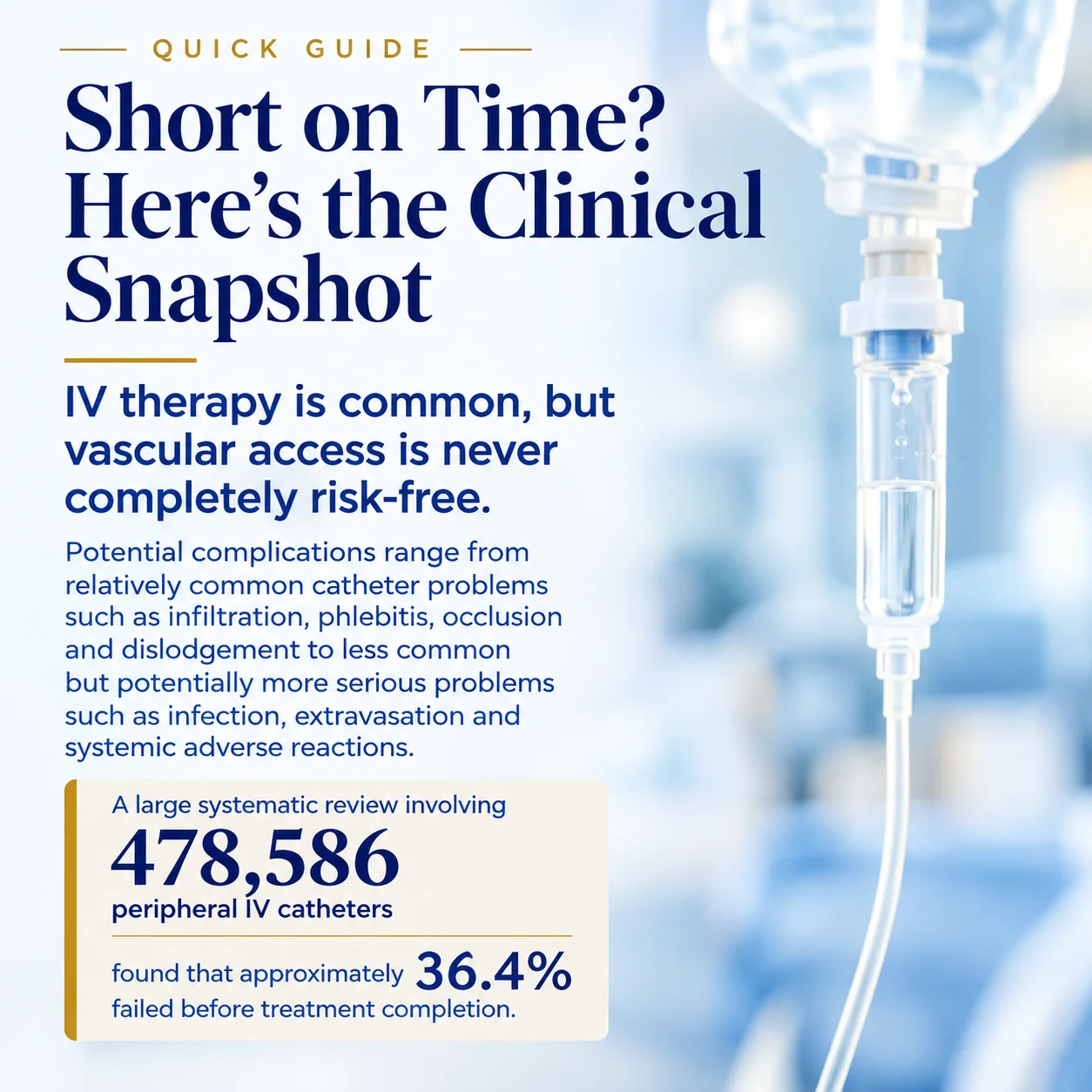
Short on Time? Here's the Clinical Snapshot
IV therapy is common, but vascular access is never completely risk-free.
Potential complications range from relatively common catheter problems such as infiltration, phlebitis, occlusion and dislodgement to less common but potentially more serious problems such as infection, extravasation and systemic adverse reactions.
A large systematic review involving 478,586 peripheral IV catheters found that approximately 36.4% failed before treatment completion. Bloodstream infection was far less common per catheter, but its potential consequences mean infection prevention remains essential.
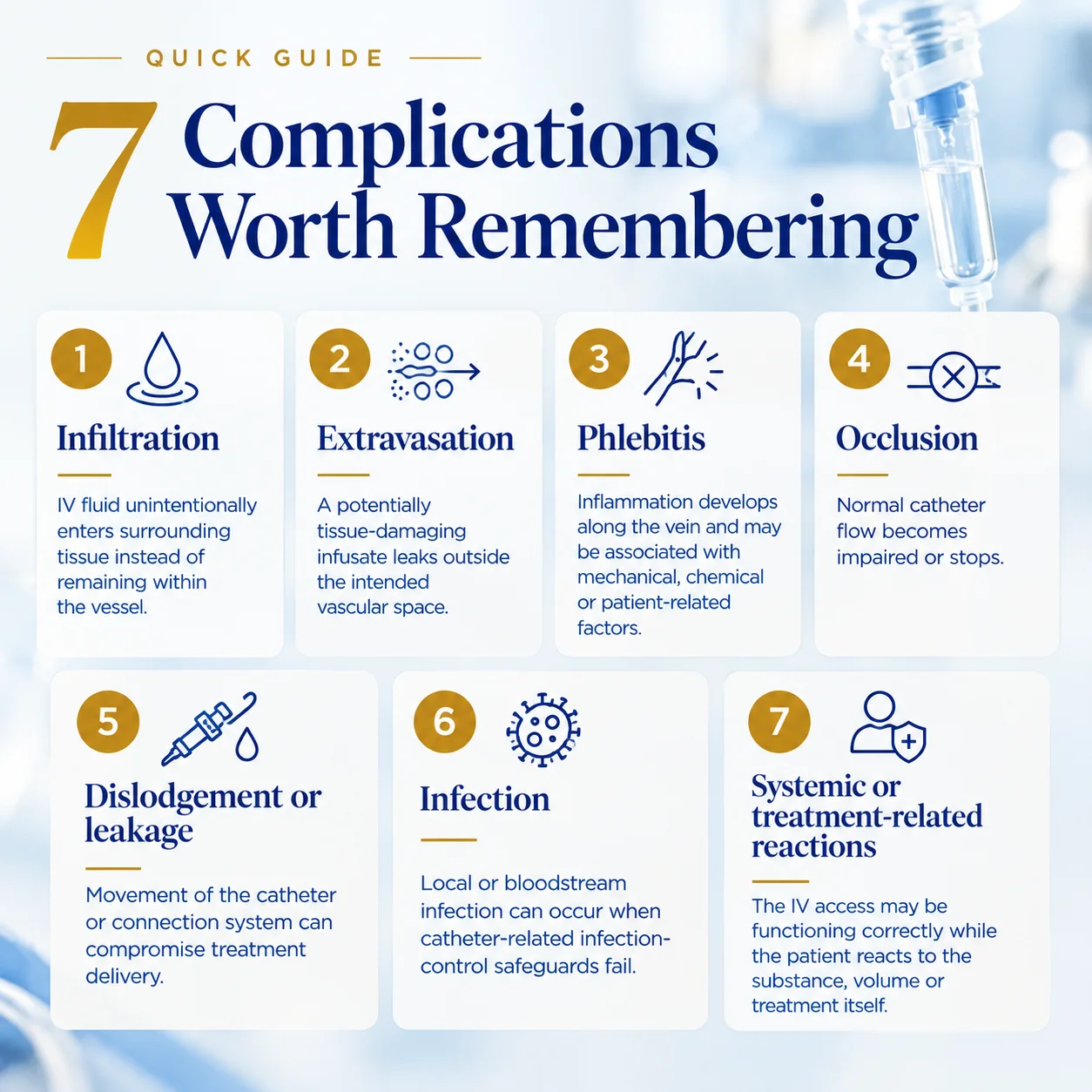
The 7 complications worth remembering
The CBAM Four-Layer IV Safety Model
Rather than memorizing complications as an isolated list, think about IV safety across four layers:
Ask four questions:
- Patient: Is this treatment appropriate for this person?
- Access: Is vascular access safe and functioning?
- Infusion: Is the treatment itself appropriate?
- Monitoring: Are changes being recognized early?
For the broader clinical picture, including patient assessment, IV principles, safety and clinical applications, continue with the CBAM IV Therapy Guide.
IV Therapy Safety Starts Before the IV
When clinicians think about IV complications, they often think first about what happens around the catheter: swelling, pain, redness, leakage or loss of flow.
Those matter.
But they represent only one part of the safety equation.
Consider two patients. The first develops infiltration despite otherwise appropriate treatment. The second has perfectly functioning vascular access—but the treatment being administered is inappropriate for their clinical situation.
Both represent IV safety problems. Only one is primarily a catheter problem.
This distinction is important because IV therapy combines at least four clinical elements:
- the patient,
- the vascular access,
- the substance being administered,
- and the patient's response to treatment.
That is why complication prevention should begin with assessment rather than insertion.
How Common Are Peripheral IV Complications?
Peripheral IV catheters are used extensively throughout healthcare. Yet catheter failure is not unusual.
A 2024 systematic review and meta-analysis evaluated 69 studies representing 478,586 peripheral intravenous catheters. The researchers found that all-cause peripheral IV catheter failure before treatment completion occurred in approximately 36.4% of catheters.
Catheter-associated bloodstream infection was much less common—approximately 0.028% per catheter in the pooled analysis.
The numbers reveal an important clinical distinction:
Peripheral catheter failure is common enough to matter operationally and clinically. Bloodstream infection is much less common per catheter, but its seriousness means infection prevention cannot be treated casually.
Understanding Each Layer of IV Safety
Layer 1 — Patient
Should this patient receive this treatment?
Potential considerations may include:
- medical history;
- medications and supplements;
- allergies;
- previous reactions;
- cardiovascular considerations;
- renal considerations;
- pregnancy where relevant;
- relevant laboratory information where indicated;
- the reason for treatment;
- treatment-specific contraindications.
Layer 2 — Access
Is vascular access safe and functioning appropriately?
This layer includes complications such as infiltration, extravasation, phlebitis, hematoma, occlusion, leakage, dislodgement and catheter failure.
The catheter site therefore needs ongoing assessment rather than a one-time check after insertion. CDC guidance recommends evaluation of peripheral catheter sites and removal when signs of phlebitis, infection or catheter malfunction develop.
Layer 3 — Infusion
Is the substance and treatment plan appropriate?
Risk can also relate to:
- what is being administered;
- volume;
- concentration;
- compatibility;
- treatment-specific contraindications;
- potential interactions;
- patient-specific tolerance.
The same vascular access can carry very different clinical implications depending on what is being infused.
Layer 4 — Monitoring
Is a developing problem being recognized early?
The patient's condition and the IV site can change after treatment begins. Monitoring therefore asks:
- Has the site changed?
- Has pain increased?
- Has swelling developed?
- Has flow changed?
- Has the patient's condition changed?
- Have systemic symptoms appeared?
- Is the treatment proceeding as expected?
The safety system fails if nobody recognizes the change.
Detailed Look at Specific Complications
1. Infiltration: When Fluid Leaves the Intended Vascular Space
Infiltration occurs when IV fluid unintentionally enters surrounding tissue rather than remaining within the intended vein. The presentation can vary depending on factors such as site, volume, duration, catheter position and characteristics of the fluid.
Possible local changes may include swelling, discomfort, coolness, leakage, changes in flow and altered appearance around the insertion site.
2. Extravasation: Why the Infusate Matters
Infiltration and extravasation are sometimes discussed as though they mean exactly the same thing. Clinically, the distinction matters.
Extravasation generally refers to unintended leakage of an infusate capable of causing greater local tissue injury. This introduces an important principle:
Two access failures may therefore have very different clinical consequences. This is also why there cannot be one universal response for every form of extravasation. Management depends on the specific substance, presentation and applicable clinical guidance.
3. Phlebitis: More Than Redness Around an IV
Phlebitis refers to inflammation of a vein. It may be influenced by multiple factors rather than one single cause. These can include:
- Mechanical factors — Movement or physical irritation associated with the catheter.
- Chemical factors — Characteristics of the administered substance.
- Patient-related factors — Individual vascular and clinical characteristics.
Possible findings may include pain, tenderness, warmth, erythema or changes along the vein. CDC guidance specifically identifies warmth, tenderness, erythema and a palpable venous cord among signs that should prompt removal of a peripheral venous catheter.
4. Occlusion: When Normal Catheter Function Changes
A catheter that suddenly stops functioning normally should not simply be considered inconvenient. A change in flow is information.
The clinically useful question is not: "How do I make it flow again?" The first question should be: "Why has normal function changed?"
5. Dislodgement and Leakage
Peripheral IV catheters exist within a moving patient. Movement, inadequate securement or changes around the insertion site can affect catheter position and function.
Possible consequences can include leakage, interrupted therapy, infiltration, loss of vascular access and need for catheter replacement.
Securement therefore may look like a small operational detail, but it contributes to a much larger safety system. The catheter must not simply be inserted successfully. It has to remain appropriately positioned and functional.
6. Hematoma and Local Bleeding
Establishing vascular access requires vessel puncture. Local bleeding and hematoma can therefore occur. The significance of these complications can differ according to patient characteristics.
Before treatment, relevant considerations may include medication history, anticoagulant or antiplatelet use where relevant, previous bleeding problems, vascular fragility, previous access difficulties and underlying medical conditions.
Again, the pattern becomes clear: Complication prevention begins before the needle reaches the skin.
7. Infection: Uncommon Per Catheter, Important at Scale
Infection deserves separate attention because frequency and severity can easily be confused. The large 2024 systematic review found catheter-associated bloodstream infection in approximately 0.028% of peripheral IV catheters, while local infection was estimated at approximately 0.15%.
Those percentages appear small. But peripheral IV catheters are used on an enormous scale globally. Even a relatively uncommon event can therefore create a substantial clinical burden.
Infection prevention is consequently not limited to checking for redness after insertion. It involves a chain of safeguards:
CDC recommendations emphasize hand hygiene, aseptic technique, trained personnel and ongoing catheter-site assessment as core elements of intravascular catheter safety.
8. Adverse Reactions: When the Catheter Isn't the Problem
This is one of the most important distinctions for clinicians working in IV wellness, longevity and aesthetic settings. Sometimes the vascular access is functioning perfectly. The problem is the patient's response to what is being administered.
Depending on the treatment, relevant considerations can include allergy history, current medications, medical conditions, previous infusion reactions, ingredients, dose, volume, potential interactions and treatment-specific contraindications.
9. Fluid-Related Risk
Another common oversimplification is assuming that because a fluid is routinely used, it carries the same risk for every patient. It does not. Volume and composition may have different implications in patients with certain cardiovascular, renal or other medical conditions.
Protocols can support clinical practice. They cannot replace individualized assessment.
The Most Important IV Safety Step May Happen Before Insertion
Suppose a practitioner performs technically excellent vascular access. The catheter is secure. There is no infiltration. There is no phlebitis. Everything appears perfect.
But the patient should never have received that particular treatment.
Was the procedure safe?
No.
This illustrates why pre-treatment assessment belongs at the center of IV safety.
Depending on the treatment and clinical context, assessment may consider:
- medical history;
- current medications;
- supplements;
- known allergies;
- previous infusion reactions;
- renal history;
- cardiovascular history;
- treatment objective;
- pregnancy where relevant;
- relevant laboratory findings where indicated;
- contraindications associated with the proposed treatment.
Our dedicated article on Patient Assessment Before IV Therapy explores this part of the pathway in greater detail.
For the broader topic, the CBAM IV Therapy Guide connects patient assessment with IV principles, clinical applications, safety and treatment considerations.
Prevention Is a System, Not a Checklist
Healthcare professionals naturally like checklists. They are useful. But IV safety is better understood as a connected system:
A weakness anywhere in that chain can increase risk. This is one reason why teaching only "how to start an IV" provides an incomplete understanding of IV therapy.
What Does the Evidence Say About Prevention?
This is an area where clinicians should also be careful not to overstate certainty. A 2024 systematic review examined 105 studies assessing infection-prevention and complication-reduction interventions for peripheral IV catheters. The researchers found varying levels of evidence across interventions and highlighted significant gaps in high-quality research for several commonly used measures.
That matters. Not every routine practice has the same level of supporting evidence.
At the same time, established infection-control principles remain important. CDC recommendations include healthcare-worker education, demonstrated competence, appropriate catheter selection, hand hygiene, aseptic technique and regular site assessment.
It is: Use established safety standards while remaining willing to update practice as stronger evidence emerges.
Expected Treatment Experience or Developing Complication?
One of the harder skills in clinical practice is recognizing when something has changed. Rather than memorizing only individual warning signs, practitioners can repeatedly ask:
Has the site changed?
- New swelling?
- New redness?
- New leakage?
Has the sensation changed?
- Increasing discomfort?
- Tenderness?
- Unexpected pain?
Has the catheter changed?
- Different flow?
- Resistance?
- Loss of function?
Has the patient changed?
- New systemic symptoms?
- Unexpected response?
- Change from baseline?
This approach makes monitoring dynamic. The practitioner is not simply looking for a predefined complication. They are looking for deviation from the expected course.
The Difference Between a Protocol and Clinical Reasoning
Protocols are valuable. They help standardize care and reduce unnecessary variation. But a protocol cannot represent every patient.
Consider the difference between these two approaches:
Protocol thinking
"Step 4 says to do X."
Clinical reasoning
"Why does Step 4 exist, what risk is it addressing, and does this patient's situation require a different response?"
The second practitioner understands the system behind the protocol. That distinction becomes particularly important when something unexpected occurs.
When Does an IV Problem Become an Escalation Problem?
Not every complication has the same clinical significance. Some issues may be localized and readily addressed within the practitioner's authorized clinical role. Others may require another clinician, medical evaluation, urgent escalation or emergency services.
A clinic offering IV therapy should therefore establish its escalation pathway before an adverse event occurs. Practitioners should know:
- which events they are authorized and trained to manage;
- when treatment should be discontinued;
- when another clinician should become involved;
- when urgent or emergency assessment is necessary;
- how the event should be documented;
- what follow-up is required.
Why This Matters Beyond Hospitals
IV therapy is no longer confined to inpatient medical environments. It is increasingly encountered in wellness clinics, aesthetic practices, longevity medicine, integrative medicine, hydration clinics and mobile IV services.
The environment may feel different from a hospital. The basic principles of clinical safety do not disappear.
A responsible IV program therefore needs more than a treatment menu. It needs systems for:
- patient selection
- documentation
- infection prevention
- treatment governance
- monitoring
- adverse-event recognition
- emergency preparedness
- scope of practice
- and quality assurance
Where IV Therapy Training Fits
Healthcare professionals who want to develop competence in IV therapy need more than isolated complication knowledge. A structured educational pathway should connect:
Who may or may not be an appropriate candidate?
How does intravenous administration differ from other routes?
How should peripheral access be understood and monitored?
What does the proposed infusion mean for this particular patient?
What changes require attention?
When does the situation move beyond routine treatment?
Healthcare professionals seeking focused education in this area can explore CBAM's IV Therapy Certificate Course Online.
For a broader educational overview before considering a course, start with the CBAM IV Therapy Guide.
From Knowing Complications to Understanding Why They Happen
There is a major difference between being able to list: "infiltration, phlebitis, infection, occlusion…" and understanding:
- Why did the problem occur?
- Could the risk have been identified earlier?
- Was the patient appropriately selected?
- Was vascular access functioning normally?
- Did something change during treatment?
- Was the change recognized quickly?
- Was escalation appropriate?
That is where IV education becomes clinically meaningful.
The CBAM Four-Layer Safety Check
If you remember only one framework from this article, remember these four questions:
Should this patient receive this treatment?
Is vascular access safe and functioning?
Is the treatment itself appropriate?
Is the patient's response being actively reassessed?
A complication can emerge at any of these four layers. That is why IV safety cannot begin and end with successful cannulation.
Clinical Takeaways
IV therapy complications should not be understood as a list of isolated adverse events. They belong to a larger clinical system.
Peripheral catheter problems such as infiltration, phlebitis, occlusion and dislodgement are important. So are infection, systemic reactions and treatment-related risks.
But the most important lesson is broader:
For healthcare professionals, the goal is therefore not simply to know what can go wrong. It is to understand:
- where risk can emerge,
- how change can be recognized,
- what can potentially be prevented,
- and when escalation becomes necessary.
That is the difference between learning an IV procedure and understanding IV therapy.
Frequently Asked Questions
Peripheral IV complications can include infiltration, phlebitis, occlusion, leakage, dislodgement, pain, hematoma and catheter failure. Extravasation, infection and systemic adverse reactions may be less common but can carry greater clinical significance.
A large systematic review involving 478,586 peripheral IV catheters estimated all-cause failure before treatment completion at approximately 36.4%.
Yes. Local and bloodstream infections can occur in association with peripheral IV catheters. Bloodstream infection is uncommon per peripheral catheter, but prevention remains important because of its potential severity and the enormous number of catheters used.
Both involve unintended movement of fluid outside the intended vascular space. Extravasation generally refers to leakage involving a substance capable of causing more significant tissue injury.
Phlebitis may involve mechanical, chemical and patient-related factors. Possible signs can include warmth, tenderness, erythema and changes along the vein.
No medical procedure is completely risk-free. Appropriate patient assessment, trained personnel, aseptic practice, appropriate catheter management, monitoring and early recognition can help reduce avoidable risk.
No. Vascular access is one component. Safe IV therapy also involves patient selection, treatment appropriateness, infection prevention, monitoring and appropriate response to complications.
Online education can teach substantial theoretical content, including patient assessment, IV principles, treatment considerations, complication recognition and safety. Practical competency, licensing, supervision and scope-of-practice requirements depend on the profession and jurisdiction.
References
Marsh N, et al. Peripheral intravenous catheter infection and failure: A systematic review and meta-analysis. International Journal of Nursing Studies. 2024.
Dobrescu A, et al. Effectiveness and Safety of Measures to Prevent Infections and Other Complications Associated With Peripheral Intravenous Catheters: A Systematic Review and Meta-analysis. Clinical Infectious Diseases. 2024.
Centers for Disease Control and Prevention. Guidelines for the Prevention of Intravascular Catheter-Related Infections: Summary of Recommendations.
Develop Your IV Therapy Knowledge
Healthcare professionals need structured education in IV patient assessment, safety principles, complication recognition, and clinical management. Explore focused training designed for practitioners ready to develop competence in IV therapy.