
Peptide Therapy Safety: Risks, Side Effects and Clinical Considerations
The CBAM 5-Layer Peptide Safety Framework
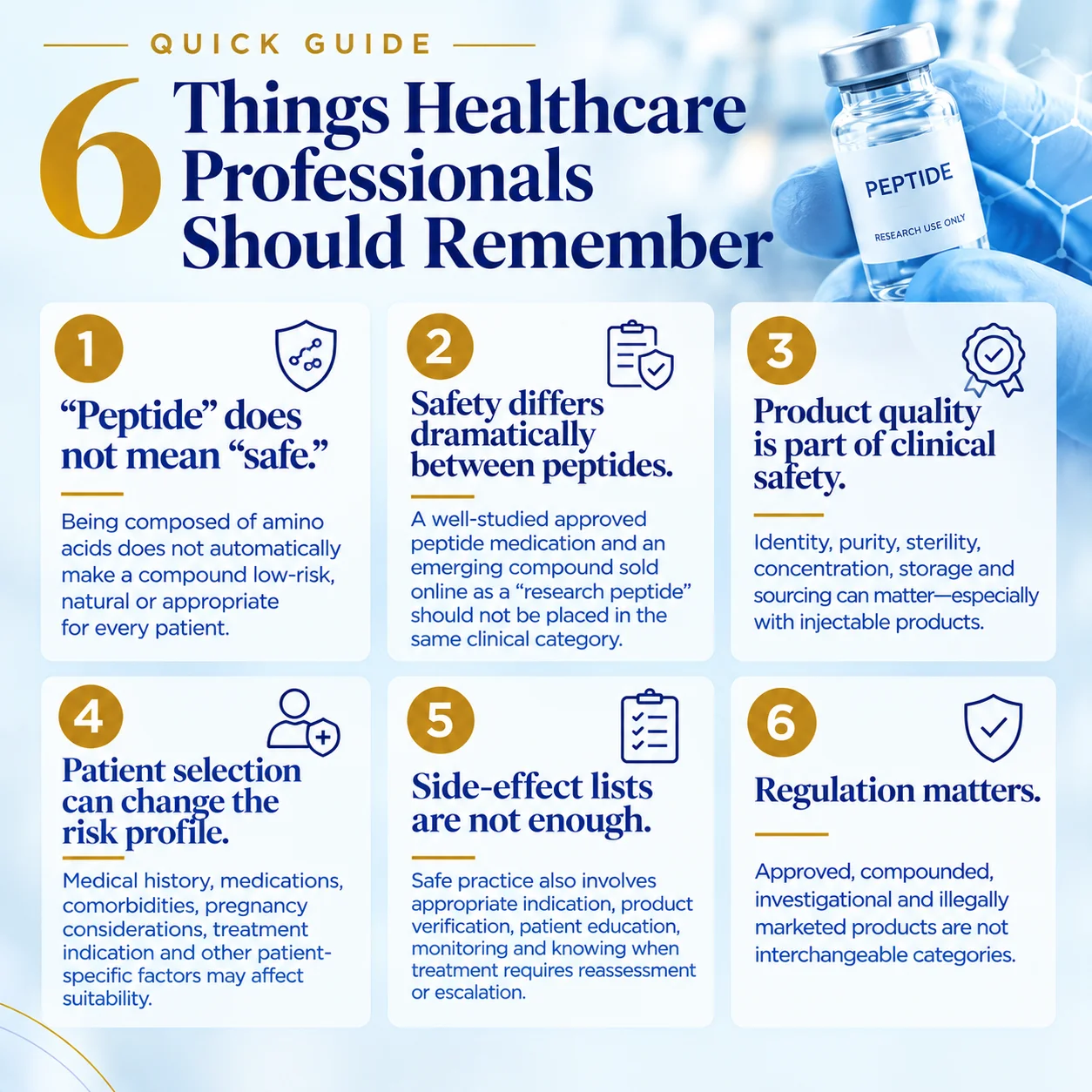
Before thinking of peptide safety as a list of adverse effects, evaluate five layers:
- Patient
- Is this patient an appropriate candidate?
- Peptide
- What compound are we actually discussing, and what evidence exists?
- Product
- What is its regulatory status, source and quality context?
- Plan
- Is there a clinically justified treatment objective and management strategy?
- Monitoring
- How will effectiveness, tolerance and emerging problems be assessed?
Bottom line: Peptide safety begins long before a dose is administered. It begins with identifying exactly what is being used, why it is being considered and whether the evidence supports its use in that patient.
For a broader overview of mechanisms, evidence, applications, regulation and professional education, see the CBAM Peptide Therapy Guide.
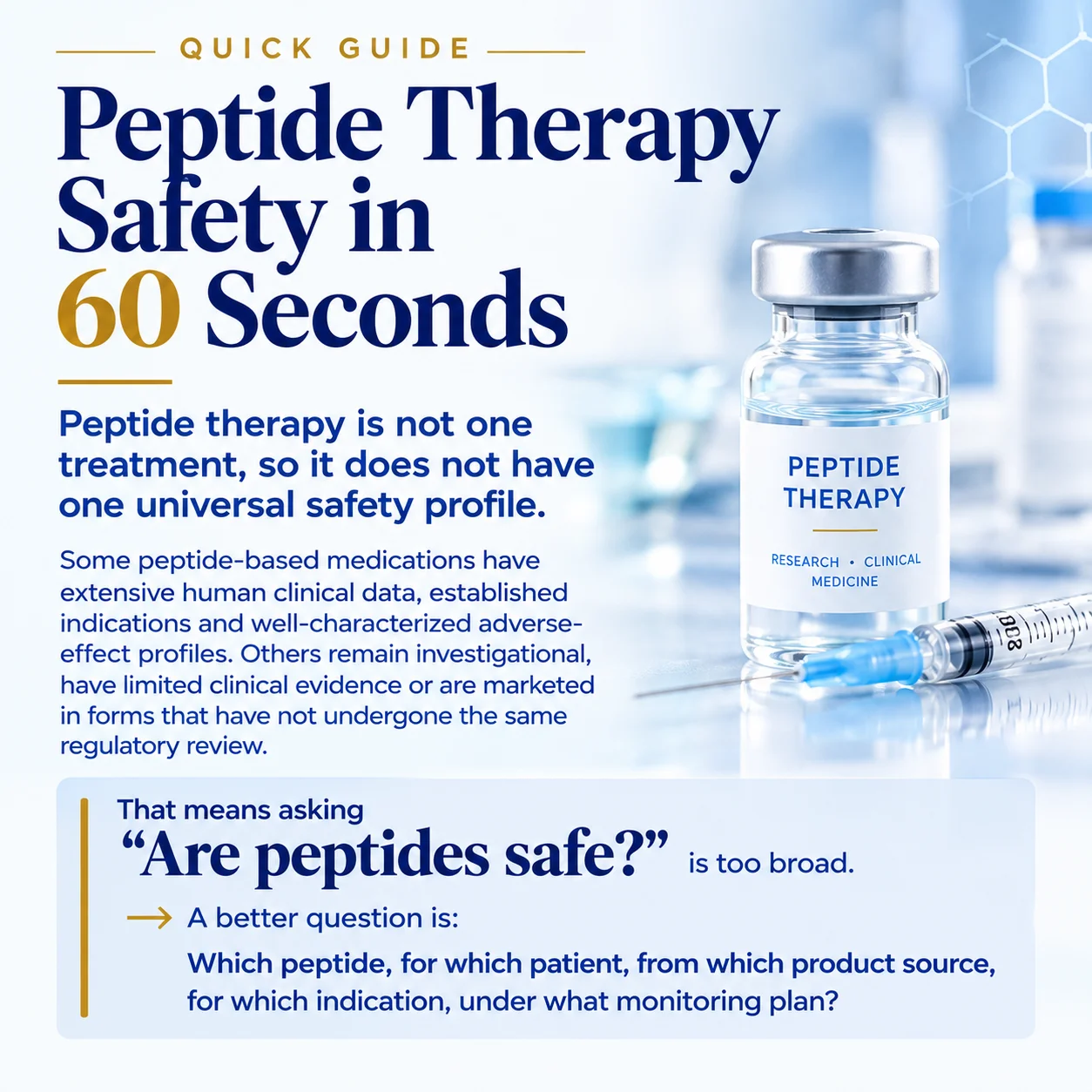
Is Peptide Therapy Safe?
The most accurate answer is:
It depends on the peptide.
The term peptide therapy describes an extremely broad group of compounds.
Peptides are short chains of amino acids, but their biological effects can differ substantially depending on:
- amino-acid sequence;
- receptor target;
- pharmacological activity;
- route of administration;
- dose;
- indication;
- patient population;
- product formulation.
This makes broad statements such as:
“Peptides are safe because they are natural”
clinically unhelpful.
Many biologically powerful substances are naturally occurring or structurally related to substances produced by the body.
That does not make them universally safe.
A better starting principle is:
Safety belongs to a specific therapy used in a specific clinical context—not to the word “peptide.”
The First Safety Question: Which Peptide Are We Talking About?
This question sounds obvious.
In practice, it is often skipped.
Online discussions frequently group compounds together under terms such as:
- anti-aging peptides;
- healing peptides;
- weight-loss peptides;
- muscle-building peptides;
- metabolic peptides;
- regenerative peptides.
These are marketing or descriptive categories—not standardized safety classifications.
Two compounds marketed under the same category may have:
- completely different mechanisms;
- different levels of human evidence;
- different adverse effects;
- different contraindications;
- different regulatory status.
Healthcare professionals should therefore move immediately from the category to the compound.
Instead of:
“Are weight-loss peptides safe?”
ask:
“What is known about the safety of this specific compound for this specific indication?”
That one change dramatically improves the quality of the clinical conversation.
Not All Peptide Evidence Is Equal
Peptide medicine spans a wide evidence spectrum.
At one end are peptide-based medications that have undergone extensive clinical development.
At the other are compounds promoted online despite limited human evidence.
Between those extremes is a large emerging category.
A useful way to think about this is:
Established
Human clinical evidence is substantial and safety characteristics are comparatively well defined for specific indications.
Emerging
There may be plausible mechanisms and some human data, but important questions remain.
Investigational
Clinical evidence may still be preliminary or limited to specific research contexts.
Marketing Ahead of Evidence
Claims about effectiveness or safety extend beyond what available clinical evidence can reasonably support.
This classification is important because popularity does not move a compound from one evidence category into another.
“Natural” Does Not Mean Risk-Free
One of the most persistent misconceptions surrounding peptide therapy is the assumption that peptides must be inherently safer because many peptides resemble naturally occurring signaling molecules.
This reasoning has a fundamental problem.
Biological activity is exactly why peptide-based therapies can be clinically useful.
But biological activity can also produce unwanted effects.
The clinically relevant questions are therefore:
- Which receptor or pathway does the compound influence?
- How selective is that activity?
- What happens at therapeutic exposure?
- What adverse events have been documented?
- What happens in different patient populations?
- What interactions or contraindications matter?
- What long-term data exist?
“Natural” answers none of these questions.
The CBAM 5-Layer Peptide Safety Framework
Peptide safety becomes easier to evaluate when it is divided into five layers.
Layer 1 — Patient
Is this patient an appropriate candidate?
Before discussing a peptide, the practitioner needs to understand the patient.
Depending on the treatment under consideration, relevant factors may include:
- medical history;
- current diagnoses;
- medications;
- supplements;
- previous reactions;
- pregnancy or reproductive considerations;
- renal or hepatic considerations;
- metabolic or endocrine history;
- allergies;
- treatment goals;
- relevant laboratory information where clinically indicated.
The specific assessment must match the therapy.
There is no universal peptide screening checklist that applies equally to every compound.
That itself is an important safety principle.
Layer 2 — Peptide
What exactly is the compound?
The practitioner should be able to identify:
- the specific molecule;
- proposed mechanism;
- intended indication;
- available human evidence;
- known adverse effects;
- relevant contraindications;
- regulatory status.
A vague label such as “regenerative peptide” is insufficient.
Clinical decisions require specificity.
Layer 3 — Product
What exactly is being supplied?
This layer is increasingly important.
The same peptide name can appear across:
- approved prescription products;
- compounded preparations;
- investigational products;
- products marketed online;
- products labelled “research use only.”
These categories are not equivalent.
Product-related considerations can include:
- identity;
- concentration;
- purity;
- sterility;
- storage;
- formulation;
- labeling;
- supply chain;
- regulatory status.
For injectable products in particular, quality and sterility are not minor operational details.
They are part of patient safety.
Layer 4 — Plan
Why is this treatment being considered?
Clinical use should have a defensible objective.
Ask:
- What is the indication?
- What outcome is expected?
- What evidence supports that outcome?
- How will benefit be evaluated?
- What is the treatment duration?
- What happens if treatment is ineffective?
- What happens if adverse effects develop?
A treatment plan without a defined endpoint can easily become indefinite treatment without meaningful reassessment.
Layer 5 — Monitoring
What happens after treatment begins?
Safety is dynamic.
A patient who appears appropriate before treatment may experience:
- intolerance;
- unexpected adverse effects;
- inadequate response;
- clinically relevant changes;
- new medications;
- new diagnoses.
Monitoring should therefore be matched to the specific therapy and patient.
The important principle is:
Prescribing or administering a treatment is not the end of clinical decision-making. It begins another phase of it.
What Are the Possible Side Effects of Peptide Therapy?
There is no scientifically accurate universal list of “peptide therapy side effects.”
Side effects depend on the specific compound.
Potential adverse effects discussed across different peptide-based therapies may include categories such as:
- gastrointestinal symptoms;
- injection-site reactions;
- hypersensitivity;
- headache;
- fatigue;
- appetite changes;
- metabolic effects;
- fluid-related changes;
- endocrine effects.
But listing these together without identifying the responsible compounds can create another form of misinformation.
For example, the adverse-effect profile of a GLP-1 receptor agonist should not automatically be attributed to an unrelated peptide used for another indication.
Therefore:
Side effects should be discussed compound by compound—not category by category.
What GLP-1 Therapies Teach Us About Peptide Safety
GLP-1-based therapies provide a useful case study because they are among the most visible peptide-related medications in current medicine.
Their widespread use has produced extensive clinical data.
It has also created several misconceptions.
Approved semaglutide and tirzepatide products have defined prescribing information, indications, contraindications, warnings and adverse-effect profiles.
Serious risks identified in current FDA labeling include considerations such as severe gastrointestinal adverse reactions, acute kidney injury associated with volume depletion, gallbladder disease, pancreatitis, hypersensitivity and other treatment-specific warnings.
But there is another lesson.
Safety information changes as evidence evolves.
In January 2026, the FDA announced that its comprehensive evaluation did not identify an increased risk of suicidal ideation or behavior with GLP-1 receptor agonist medications and requested removal of that warning from relevant product labeling.
That is what evidence-based medicine should look like:
Safety knowledge is not static.
Approved and Unapproved Products Are Not Equivalent
This distinction has become increasingly important in 2026.
The FDA has repeatedly warned about unapproved versions of semaglutide and tirzepatide marketed for weight loss.
According to the agency, unapproved versions do not undergo FDA premarket review for:
- safety;
- effectiveness;
- quality.
The FDA has also identified concerns involving:
- dosing errors;
- fraudulent compounded products;
- inappropriate salt forms of semaglutide;
- illegal online sales;
- products falsely labelled for research purposes;
- products of uncertain quality.
As of May 31, 2026, the FDA reported receiving 990 adverse-event reports associated with compounded semaglutide and more than 730 associated with compounded tirzepatide.
These reports do not prove that every event was caused by the compounded product, and the FDA explicitly notes that causality cannot always be established.
That nuance matters.
The numbers should not be used to claim:
“Compounded GLP-1 products caused 1,720 adverse events.”
The accurate statement is:
FDA received those reports in association with compounded products, and causality may not always be determinable.
That distinction is exactly the kind of evidence literacy healthcare professionals need.
The “Research Peptide” Problem
Another increasingly visible category involves products sold online as:
“Research use only”
or:
“Not for human consumption.”
Yet some are simultaneously promoted through language that strongly implies human therapeutic use.
In August 2026, FDA warning letters addressed companies selling compounds including semaglutide, tirzepatide, retatrutide, SS-31, tesamorelin and other peptide-related products as unapproved drugs.
For clinicians, the important lesson is broader than any one company.
A website selling a peptide does not establish:
- regulatory approval;
- pharmaceutical quality;
- clinical effectiveness;
- safety;
- appropriate human use.
Commercial availability should never be confused with clinical legitimacy.
Product Quality Is a Clinical Issue
Healthcare professionals sometimes separate “clinical medicine” from “supply chain.”
With peptide therapies, that separation can be dangerous.
Consider an injectable product.
Even if the molecule itself has legitimate clinical evidence, patient safety can still be affected by:
- incorrect concentration;
- contamination;
- sterility failure;
- inappropriate storage;
- degradation;
- labeling errors;
- counterfeit products.
This leads to an important principle:
A clinically appropriate molecule can still become an inappropriate product.
Product verification therefore belongs inside clinical safety—not outside it.
Patient Selection Matters More Than Peptide Popularity
A therapy can be supported by good evidence and still be inappropriate for a particular patient.
That is true across medicine.
Peptide therapy is no exception.
Patient selection may require consideration of:
- treatment indication;
- medical history;
- medication history;
- comorbidities;
- previous treatment response;
- allergies;
- pregnancy considerations;
- treatment expectations;
- ability to comply with monitoring;
- jurisdictional prescribing requirements.
This is why protocol-driven peptide treatment has limitations.
A protocol can organize care.
It cannot replace patient-specific clinical judgment.
Peptide Safety Is More Than Avoiding Side Effects
If a patient experiences no obvious adverse effects, does that automatically mean treatment is safe?
Not necessarily.
A broader safety model includes at least four questions:
Is the treatment causing harm?
Traditional adverse-event monitoring.
Is the treatment achieving anything meaningful?
An ineffective intervention still exposes the patient to cost, burden and potential risk.
Is the evidence appropriate for the claim being made?
Clinical marketing should not exceed clinical evidence.
Is continued treatment justified?
Treatment should be reassessed rather than continued indefinitely by default.
This is why effectiveness and safety cannot always be completely separated.
What Should Be Monitored During Peptide Therapy?
There is no universal monitoring protocol for all peptides.
Monitoring depends on:
- compound;
- indication;
- patient;
- route;
- duration;
- known adverse-effect profile.
However, a general clinical monitoring mindset can include:
Response
Is the intended outcome occurring?
Tolerance
Is the patient experiencing adverse effects?
New Clinical Information
Has the patient’s medical status changed?
Medication Changes
Has another treatment been started or stopped?
Continued Appropriateness
Does the original rationale for treatment still apply?
The goal is not simply to continue treatment.
The goal is to continue appropriate treatment.
How Healthcare Professionals Should Evaluate a New Peptide
New peptide compounds and claims appear quickly.
A practitioner cannot memorize every new product.
A reusable evaluation process is therefore more valuable.
When encountering a new peptide, ask:
1. What is it?
Identify the exact compound.
2. How is it supposed to work?
Understand the proposed mechanism.
3. What human evidence exists?
Look for meaningful clinical outcomes.
4. What safety data exist?
Separate human safety data from assumptions based on mechanism.
5. What is its regulatory status?
Approved?
Compounded?
Investigational?
Unapproved?
6. What product is actually being supplied?
Source and formulation matter.
7. Who was studied?
Evidence from one population may not automatically apply to another.
8. What remains unknown?
Long-term safety?
Interactions?
Optimal duration?
Comparative effectiveness?
This process remains useful even as individual peptide trends change.
Red Flags in Peptide Marketing
Certain claims should trigger additional scrutiny.
“No side effects”
Very few biologically active therapies can responsibly be described this way.
“100% safe”
Absolute safety claims are generally incompatible with serious clinical reasoning.
“Natural, therefore safe”
Natural origin does not establish safety.
“Clinically proven”
Which trial?
Which population?
Which endpoint?
“Works like [approved medication]”
Similar marketing language does not establish equivalent pharmacology or clinical evidence.
“Doctors are already using it”
Clinical use is not equivalent to regulatory approval or proven efficacy.
“Research peptide”
Research labeling does not make a product appropriate for human clinical use.
A good clinician should be able to interrogate each of these claims.
Regulation Is Part of Peptide Safety
Peptide therapy exists at the intersection of medicine, pharmacy, regulation and rapidly evolving commercial demand.
Healthcare professionals need to distinguish between:
- regulatory approval;
- off-label prescribing;
- compounding;
- investigational use;
- illegally marketed products.
These terms are not interchangeable.
The legal framework also differs by country, state, province and professional role.
For this reason, completing a peptide therapy course does not automatically grant authority to prescribe or administer every peptide discussed during education.
Healthcare professionals remain responsible for their:
- professional licence;
- prescribing authority;
- local law;
- employer policies;
- clinical privileges;
- scope-of-practice requirements.
What Good Peptide Education Should Teach
Peptide education should not simply provide a catalogue of compounds.
A stronger curriculum teaches practitioners how to evaluate a compound they have never encountered before.
That requires understanding:
Peptide Science
What are peptides and how do they signal biologically?
Mechanism
Which pathways and receptors are involved?
Evidence
What has actually been demonstrated?
Patient Selection
For whom might treatment be appropriate?
Safety
What adverse effects and uncertainties matter?
Product Quality
What exactly is being used?
Regulation
What can legally and professionally be done?
Monitoring
How should treatment be reassessed?
This approach remains valuable even when today’s popular peptide is replaced by tomorrow’s.
From Peptide Trends to Clinical Reasoning
The peptide field moves quickly.
Social media can make a compound popular before high-quality human evidence is available.
Clinicians should therefore resist building their knowledge around lists such as:
“The 10 best peptides for 2026.”
Those lists age quickly.
Clinical reasoning ages much more slowly.
The more durable questions are:
That is the framework healthcare professionals can carry from one peptide to the next.
Focused Peptide Education or Broader Regenerative Medicine Training?
Healthcare professionals may have different educational goals.
If Your Primary Interest Is Peptide Medicine
The CBAM Peptide Therapy Online Training provides structured education covering peptide science, mechanisms, clinical evaluation, safety, regulatory considerations and selected applications relevant to medical and aesthetic practice.
If You Are Still Building the Clinical Foundation
Start with the CBAM Peptide Therapy Guide.
The Guide provides the broader informational foundation before moving into structured training.
The distinction is simple:
Need to understand the field → Peptide Therapy Guide
Need structured professional education → Peptide Therapy Online Training
The CBAM 5-Layer Peptide Safety Check
If you remember one framework from this article, use this one whenever you encounter a peptide therapy:
-
PATIENT
Is this an appropriate patient?
-
PEPTIDE
What compound is actually being considered?
-
PRODUCT
What exactly is being supplied and what is its regulatory/quality context?
-
PLAN
Why is it being used and what outcome is expected?
-
MONITORING
How will effectiveness, tolerance and continued appropriateness be assessed?
If one of these five questions cannot be answered, there is a gap in the safety assessment.
Clinical Takeaways
The question “Is peptide therapy safe?” sounds simple.
Clinically, it is not.
Peptide therapy includes compounds with dramatically different:
- mechanisms;
- evidence bases;
- indications;
- adverse-effect profiles;
- product-quality considerations;
- regulatory status.
Healthcare professionals should therefore avoid treating “peptides” as a single therapeutic class with a universal safety profile.
Instead, evaluate safety across five layers:
The most important skill is not memorizing every potential side effect of every popular peptide.
It is developing a system for evaluating new compounds, new evidence and new claims as the field evolves.
That is what turns peptide knowledge into clinical reasoning.
Frequently Asked Questions
Is peptide therapy safe?
What are the most common side effects of peptide therapy?
Are peptide injections safe?
Are research peptides safe for human use?
Are compounded peptides FDA-approved?
Are GLP-1 medications peptide therapies?
Does peptide therapy certification allow a practitioner to prescribe peptides?
How should healthcare professionals evaluate emerging peptides?
References
- U.S. Food and Drug Administration. FDA’s Concerns with Unapproved GLP-1 Drugs Used for Weight Loss. Updated 2026.
- U.S. Food and Drug Administration. FDA Intends to Take Action Against Non-FDA-Approved GLP-1 Drugs. February 2026.
- U.S. Food and Drug Administration. FDA Requests Removal of Suicidal Behavior and Ideation Warning from GLP-1 Receptor Agonist Medications. January 2026.
- U.S. Food and Drug Administration. Warning letters concerning unapproved peptide-related drug products marketed in 2026.
Ready to Build Structured Peptide Therapy Knowledge?
Evidence-informed education in peptide science, clinical evaluation, safety, regulation and selected applications for healthcare professionals.
Explore the Peptide Therapy Online Training
Have questions or want to discuss your learning goals?
Share your thoughts in the comments below