

PRP for Hair Loss: What Does the Clinical Evidence Show?
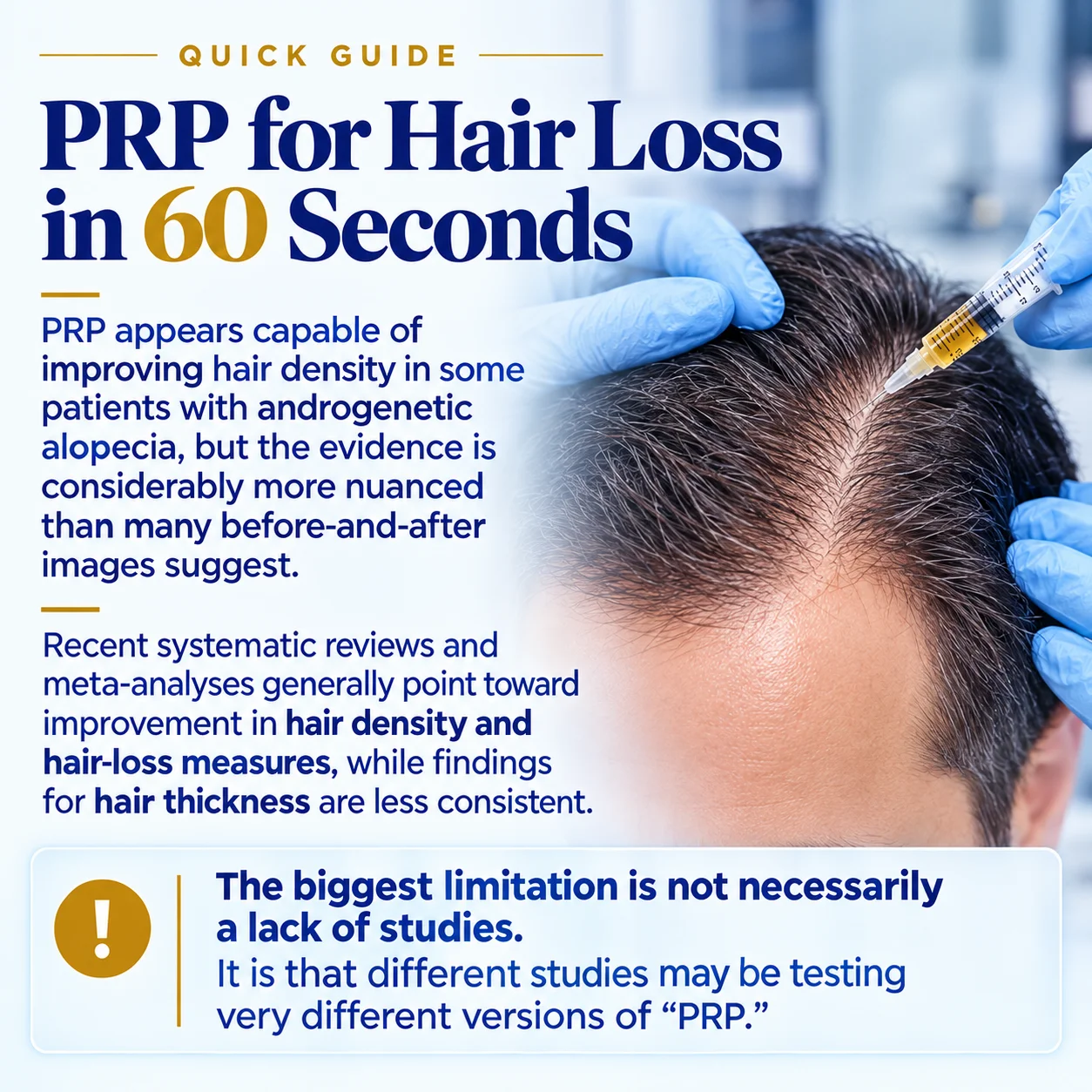
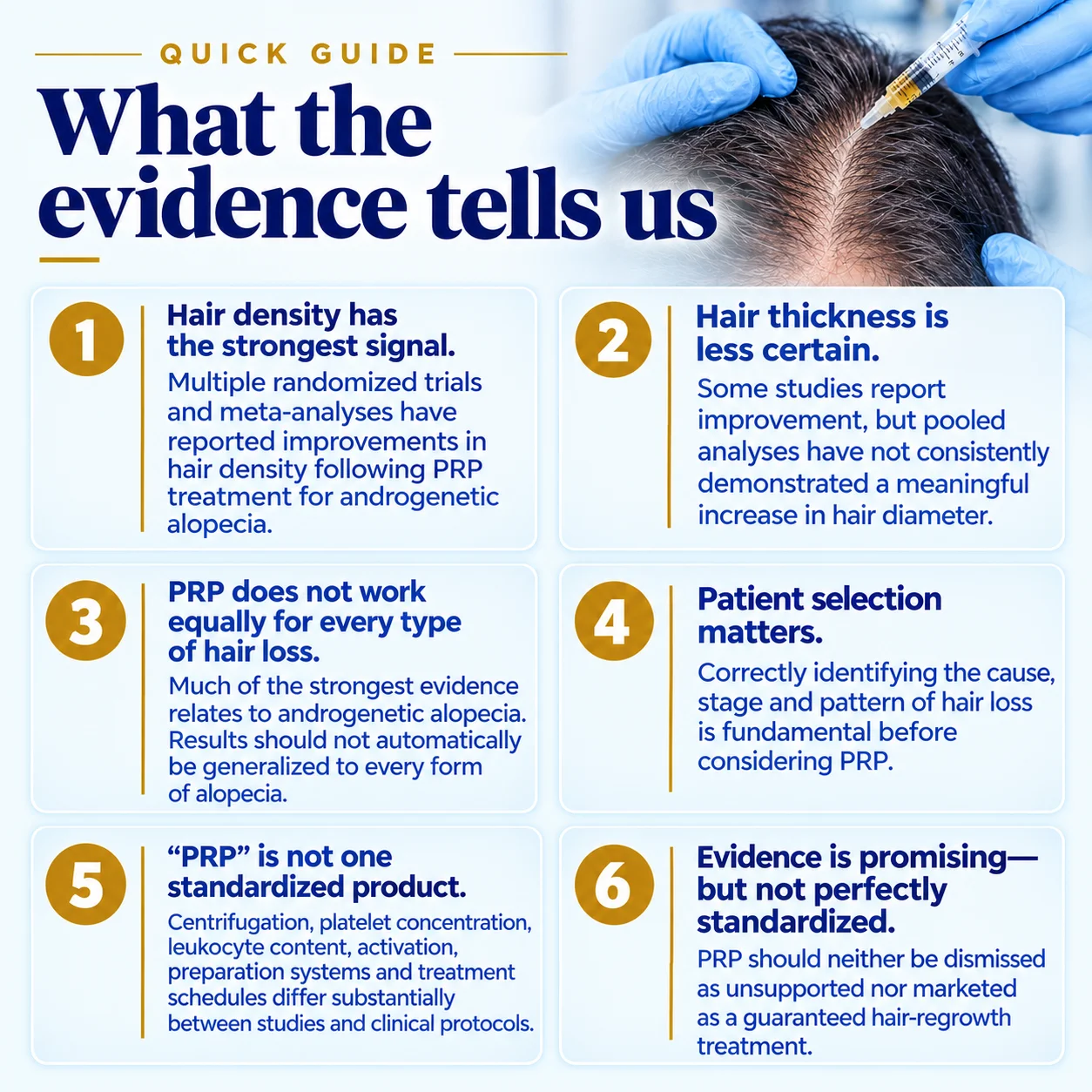
The most useful clinical interpretation
Instead of asking:
“Does PRP grow hair?”
a better question is:
For which patients, with which type of hair loss, using what PRP preparation, and measured by which outcome does the evidence suggest benefit?
That is the question this article explores.
For the broader clinical foundation—including platelet biology, PRP preparation, hair and skin applications, safety and PRF—see the CBAM PRP Training Guide for Skin & Hair.
What Is PRP for Hair Loss?
Platelet-rich plasma, or PRP, is an autologous blood-derived preparation produced by processing a patient’s blood to obtain a plasma fraction containing a higher platelet concentration than baseline whole blood.
Platelets are widely known for their role in hemostasis.
But they also contain intracellular granules capable of releasing biologically active signaling molecules involved in processes such as:
- tissue repair;
- angiogenesis;
- inflammation;
- cellular communication;
- extracellular-matrix activity.
This biological rationale has led researchers to investigate PRP across several medical specialties.
In hair restoration, much of the clinical interest has focused on androgenetic alopecia (AGA)—commonly known as male or female pattern hair loss.
But biological plausibility alone is not enough.
The more important question is whether PRP produces measurable clinical improvement.
That requires looking at the outcomes separately.
The CBAM PRP Hair Evidence Matrix
One of the problems with discussing whether PRP “works” is that works can mean several different things.
Hair restoration research may measure:
- hair density;
- hair count;
- hair diameter;
- hair shedding;
- photographic improvement;
- patient satisfaction;
- durability.
These outcomes should not be treated as interchangeable.
A more useful interpretation is:
This distinction is important.
A patient can experience an increase in measured hair density without every individual hair shaft becoming substantially thicker.
That is why a scientifically useful conversation should specify which outcome improved.
What Does the Evidence Say About Hair Density?
Hair density currently provides one of the clearest signals in the PRP literature.
A 2024 systematic review and meta-analysis of randomized clinical trials evaluated PRP in patients with androgenetic alopecia.
Fourteen studies involving 431 patients were included in the qualitative synthesis, with 13 entering the meta-analysis.
The pooled analysis reported an average difference of approximately:
27.55 additional hairs/cm²
favoring PRP.
At first glance, that sounds highly compelling.
But there is an important second number:
I² ≈ 96%.
That represents extremely high statistical heterogeneity.
In practical terms:
The studies did not behave as though they were all testing exactly the same intervention under the same conditions.
This does not erase the positive result.
It changes how confidently we should generalize it.
Why Heterogeneity Matters So Much in PRP Research
Suppose ten studies all claim to investigate “PRP for hair loss.”
That sounds like ten studies of the same treatment.
But they may differ in:
- blood volume collected;
- centrifugation method;
- single-spin vs double-spin preparation;
- platelet concentration;
- leukocyte concentration;
- activation method;
- final injected volume;
- treatment frequency;
- number of treatment sessions;
- patient sex;
- severity of alopecia;
- concurrent treatments;
- outcome measurement;
- follow-up duration.
At that point, PRP becomes an umbrella term covering biologically different preparations and protocols.
This is one of the central challenges in translating PRP literature into practice.
PRP Is Not One Product
This deserves particular emphasis.
Unlike a conventional pharmaceutical product manufactured to a fixed specification, PRP is prepared from the patient’s own blood.
The resulting product can vary according to the preparation system and protocol.
Two clinicians may both say:
“We use PRP.”
Yet the platelet composition and biological characteristics of what they administer may differ.
This creates a major evidence-translation problem:
If a study reports a positive outcome with one PRP preparation, can we assume another preparation will produce the same result?
Not necessarily.
This is why good PRP education should go beyond learning how to operate a centrifuge.
Healthcare professionals need to understand what the preparation process is actually producing.
Does PRP Increase Hair Thickness?
The evidence here is less convincing than for hair density.
The 2024 meta-analysis of randomized trials reported a pooled mean difference in hair diameter of approximately 2.02 μm, but the confidence interval crossed zero.
In other words, the pooled result did not provide convincing evidence of a significant improvement in hair diameter.
A more recent systematic review and meta-analysis of alopecia research similarly concluded that PRP improved hair density and reduced hair loss but did not demonstrate a significant effect on hair thickness.
This is a useful example of why saying:
“PRP improves hair growth”
can be too vague.
A more precise statement would be:
Clinical evidence currently appears stronger for improvement in hair density than for consistent increases in individual hair-shaft thickness.
That is a much more useful message for both clinicians and patients.
What About Hair Shedding?
Several studies have evaluated measures related to hair shedding, including hair-pull testing and clinical assessments.
The evidence suggests that PRP may reduce hair loss in selected patients.
A 2025 meta-analysis comparing PRP with topical minoxidil found that negative hair-pull test outcomes favored PRP in the included studies.
However, hair shedding should not be interpreted in isolation.
A reduction in shedding does not necessarily mean:
- complete reversal of alopecia;
- restoration of previously lost follicles;
- permanent treatment response.
The clinical meaning depends on the underlying diagnosis and follow-up.
PRP vs Minoxidil: Is One Better?
This is where evidence becomes especially interesting.
Minoxidil is one of the established pharmacological options used in androgenetic alopecia.
PRP has increasingly been compared with it.
A 2025 systematic review and meta-analysis examining randomized trials comparing PRP with topical minoxidil included nine RCTs and 451 participants.
The analysis did not demonstrate a clear difference between PRP and minoxidil for several objective hair-growth outcomes.
Patient satisfaction, however, favored PRP in the pooled analysis.
This does not mean:
“PRP is better than minoxidil.”
Nor does it mean:
“Minoxidil is better than PRP.”
It means that available comparative evidence does not support reducing treatment selection to a simple winner-and-loser framework.
Factors such as:
- diagnosis;
- contraindications;
- treatment preference;
- adherence;
- cost;
- tolerance;
- clinical objectives;
can all influence decision-making.
Which Type of Hair Loss Has the Strongest PRP Evidence?
The most developed evidence base currently relates to:
Androgenetic Alopecia
This includes male and female pattern hair loss.
Multiple randomized trials, systematic reviews and meta-analyses have investigated PRP in this population.
That matters because “hair loss” is not a diagnosis.
It is a symptom or clinical presentation.
Other causes may include:
- telogen effluvium;
- alopecia areata;
- scarring alopecias;
- nutritional deficiencies;
- endocrine disorders;
- medication-related hair loss;
- inflammatory scalp disease.
Evidence supporting PRP in androgenetic alopecia should not automatically be extrapolated to every other cause of hair loss.
The Diagnosis Comes Before the PRP
One of the most important mistakes in hair restoration is beginning with a treatment rather than a diagnosis.
The wrong sequence is:
Patient has hair loss → offer PRP.
The better sequence is:
PRP is not a diagnostic tool.
And treatment should not substitute for identifying why the patient is losing hair.
Who May Be a Better Candidate for PRP Hair Treatment?
Patient selection is one of the areas where clinical reasoning becomes more important than simply knowing the literature.
A potential candidate needs to be evaluated in context.
Important considerations may include:
- type of alopecia;
- pattern and severity;
- duration of hair loss;
- degree of follicular miniaturization;
- scalp health;
- medical history;
- medications;
- platelet-related or hematological considerations;
- realistic expectations;
- previous treatments;
- likelihood of adherence to the treatment plan.
The presence of hair loss alone is not sufficient.
Earlier Disease vs Advanced Follicular Loss
PRP is frequently discussed as though it can simply “regrow lost hair.”
That wording can create unrealistic expectations.
A more biologically plausible goal in androgenetic alopecia is often to support follicles that remain present but are undergoing miniaturization.
This distinction matters.
A severely miniaturized or no-longer-functional follicular environment may not respond in the same way as earlier-stage disease.
Therefore:
The presence, condition and stage of the follicular unit matter as much as the treatment being considered.
This is one reason patient selection can influence outcomes substantially.
Why Before-and-After Photos Are Not Enough
Hair restoration is visually compelling.
That makes before-and-after photography useful.
It also makes it vulnerable to misleading interpretation.
Hair appearance can change according to:
- lighting;
- hair length;
- styling;
- wet vs dry hair;
- camera angle;
- parting;
- magnification;
- contrast;
- scalp positioning.
Clinical outcome assessment should therefore be standardized where possible.
Depending on the setting, assessment may involve:
- standardized photography;
- hair density measurements;
- trichoscopy;
- hair counts;
- hair diameter measurements;
- validated patient-reported outcomes.
A photograph can illustrate a result.
It should not replace measurement.
How Long Does PRP Take to Work for Hair Loss?
Hair biology moves slowly.
Meaningful hair-restoration outcomes are therefore generally assessed over months rather than days.
Clinical trials frequently evaluate outcomes at several-month follow-up points.
This has an important implication for patient communication.
PRP should not be presented as an immediate cosmetic intervention.
The biological response, when it occurs, requires time.
Patients should understand that:
- early visual change may be limited;
- objective assessment requires consistency;
- multiple sessions may be used in clinical protocols;
- longer-term maintenance remains an area where protocols vary.
Expectation management is part of treatment quality.
How Many PRP Sessions Are Needed?
There is no universally standardized treatment schedule supported across all PRP literature.
Research protocols differ substantially.
Some studies use an initial series of treatments followed by reassessment or maintenance.
Others use different intervals.
This variability is one reason it is difficult to claim that one universal PRP protocol is “the evidence-based protocol.”
The literature supports something more nuanced:
Treatment schedules should be interpreted in the context of the specific PRP preparation, evidence base, patient and clinical objective.
Healthcare professionals should be cautious of rigid universal protocols presented without context.
What Does the Evidence Say About Long-Term Results?
This is one of the areas where more high-quality research is needed.
Many PRP studies evaluate relatively short- or medium-term outcomes.
Questions remain around:
- durability of improvement;
- optimal maintenance frequency;
- predictors of sustained response;
- long-term comparison with established therapies;
- combination strategies.
This does not make PRP ineffective.
It means the evidence is stronger for some questions than others.
PRP May Be a Treatment Strategy, Not Necessarily a Standalone Strategy
Androgenetic alopecia is a chronic condition.
For many patients, hair restoration may involve more than one intervention.
Depending on the patient’s diagnosis and clinical context, management may involve consideration of:
- established pharmacological therapies;
- PRP;
- hair transplantation;
- scalp or dermatological management;
- correction of relevant underlying factors;
- combination approaches.
PRP should therefore be considered within a broader management strategy rather than automatically framed as a replacement for every other treatment.
What About PRP for Female Pattern Hair Loss?
PRP has also been studied in female pattern hair loss.
Systematic reviews have reported encouraging results, particularly in hair-density outcomes.
However, the same methodological challenges remain:
- heterogeneous preparation protocols;
- different treatment schedules;
- small study populations;
- varying outcome measurements.
Female hair loss also requires thoughtful assessment because multiple medical, hormonal and nutritional factors can contribute to presentation.
Again:
Treatment selection should follow diagnosis—not precede it.
Is PRP for Hair Loss Safe?
Because PRP is autologous, it avoids some concerns associated with foreign biological products.
However, autologous does not mean risk-free.
PRP treatment still involves:
- blood collection;
- blood processing;
- handling of biological material;
- scalp injections.
Potential treatment-related effects can include:
- discomfort;
- tenderness;
- bruising;
- swelling;
- temporary erythema;
- bleeding;
- infection;
- vasovagal reactions.
Patient-specific medical considerations and appropriate infection-control practices remain important.
Safety therefore involves more than the PRP product itself.
The CBAM PRP Hair Decision Framework
Instead of starting with:
“Should this patient get PRP?”
start with five questions.
-
DIAGNOSIS
What is causing the hair loss?
-
FOLLICLE
Is there a biologically plausible follicular target?
-
PATIENT
Is the patient clinically appropriate for PRP?
-
PRODUCT
What PRP preparation is actually being produced?
-
OUTCOME
What exactly will define treatment success?
This creates a much stronger clinical reasoning process than simply matching “hair loss” with “PRP.”
Why PRP Preparation Matters
One of the most important lessons healthcare professionals should take from the literature is that preparation matters.
Relevant variables can include:
- platelet concentration;
- leukocyte content;
- red blood cell contamination;
- centrifugation force;
- centrifugation duration;
- number of spins;
- activation;
- final plasma volume.
These variables may influence the biological characteristics of the final preparation.
This is also one of the reasons PRP studies can be difficult to compare.
Understanding the machine is useful.
Understanding what the machine produces is more important.
What Studies Still Do Not Tell Us Clearly
Despite the growing evidence base, several questions remain incompletely answered.
What is the optimal platelet concentration?
Not fully standardized.
Which PRP preparation is best?
No universal consensus.
Is leukocyte-rich or leukocyte-poor PRP preferable for hair restoration?
The literature remains heterogeneous.
What is the ideal treatment schedule?
Not definitively established.
How often should maintenance treatment occur?
Protocols vary.
Which patients are most likely to respond?
Predictive criteria need further refinement.
How durable are results?
More standardized long-term studies are needed.
These uncertainties should not be hidden.
They are part of responsible evidence-based education.
Why This Matters for Healthcare Professionals
It is relatively easy to learn the headline:
“PRP may improve hair density.”
Clinical practice requires much more.
Healthcare professionals need to understand:
- why PRP might work;
- which patients were studied;
- which outcomes improved;
- how strong the evidence is;
- how PRP preparations differ;
- who may be an appropriate candidate;
- what the limitations are;
- what risks require consideration;
- how outcomes should be assessed.
That is the difference between learning a procedure and learning how to think clinically about a procedure.
What Good PRP Training Should Teach
High-quality PRP education should not begin and end with blood collection and centrifugation.
A stronger learning pathway includes:
-
Platelet Biology
Understand what platelets contain and why they may influence tissue signaling.
-
PRP Preparation
Understand how processing decisions change the final product.
-
Hair-Loss Assessment
Understand that alopecia requires diagnosis before treatment.
-
Patient Selection
Identify who may or may not be an appropriate candidate.
-
Evidence Interpretation
Understand what clinical research actually demonstrates.
-
Treatment Planning
Translate evidence into individualized clinical reasoning.
-
Safety
Understand procedural risks and appropriate clinical precautions.
-
Outcome Assessment
Measure whether treatment is achieving the intended objective.
That is a much more durable educational model than memorizing a single protocol.
PRP for Hair Loss: What Is the Bottom Line?
Current clinical evidence supports PRP as a promising treatment option for androgenetic alopecia, particularly for improving hair density.
But that statement needs several qualifications.
The evidence is limited by substantial heterogeneity.
PRP preparation is not standardized.
Treatment protocols differ.
Patient populations differ.
Outcome measurements differ.
Hair thickness findings are less consistent than hair-density findings.
And long-term maintenance strategies remain incompletely standardized.
Therefore, the most defensible conclusion is:
PRP has a meaningful and growing evidence base for androgenetic alopecia, particularly for hair-density outcomes, but clinical results depend on much more than simply performing “PRP.” Diagnosis, patient selection, preparation characteristics, treatment planning and outcome measurement all matter.
That is considerably more accurate than either:
“PRP doesn’t work.”
or:
“PRP regrows hair.”
Evidence-based practice lives between those extremes.
Frequently Asked Questions
Does PRP really work for hair loss?
How much can PRP increase hair density?
Does PRP make hair thicker?
Is PRP effective for female hair loss?
Is PRP better than minoxidil?
How many PRP sessions are required for hair loss?
Are PRP hair results permanent?
Is PRP safe for hair restoration?
Can PRP training be completed online?
References
- Kieling L, Konzen AT, Zanella RK, Valente DS. Is autologous platelet-rich plasma capable of increasing hair density in patients with androgenic alopecia? A systematic review and meta-analysis of randomized clinical trials. Anais Brasileiros de Dermatologia. 2024;99(6):847–862.
- Donnelly C, et al. The role of platelet-rich plasma in androgenetic alopecia: A systematic review. Journal of Cosmetic Dermatology. 2024;23(5):1551–1559.
- Platelet-Rich Plasma in the Management of Alopecia: A Systematic Review and Meta-Analysis of Clinical Evidence. 2025.
- Platelet-Rich Plasma for Androgenetic Alopecia: A Systematic Review and Meta-Analysis of Randomized Controlled Trials. 2023.
- Comparative Efficacy and Safety of Platelet Rich Plasma versus Topical Minoxidil for Androgenetic Alopecia: A Systematic Review and Meta-analysis. 2025.
Ready to Build Structured PRP Knowledge?
Evidence-informed PRP education for skin and hair, from platelet biology and preparation principles to patient selection and treatment planning.
Explore the PRP for Skin & Hair Online Training
Have questions or want to discuss your learning goals?
Share your thoughts in the comments below